AI Workforce for Shopify or Your First Hire: What to Automate
Most growing Shopify stores do not need their first employee yet: what they need first is an AI workforce for Shopify to handle the repeatable jobs. They need leverage: a way to get the repeatable work done reliably without adding payroll, management overhead, and a hiring mistake they cannot afford. The honest version of the choice is not "AI or people". It is "which jobs convert cleanly to AI execution with your approval, and which jobs still need a human brain". This article walks through that split job by job: support, creatives, ads, retention, and search, in the order that usually pays off, and it is blunt about where automation stops and you start.
Gyllion Redout · August 13, 2026
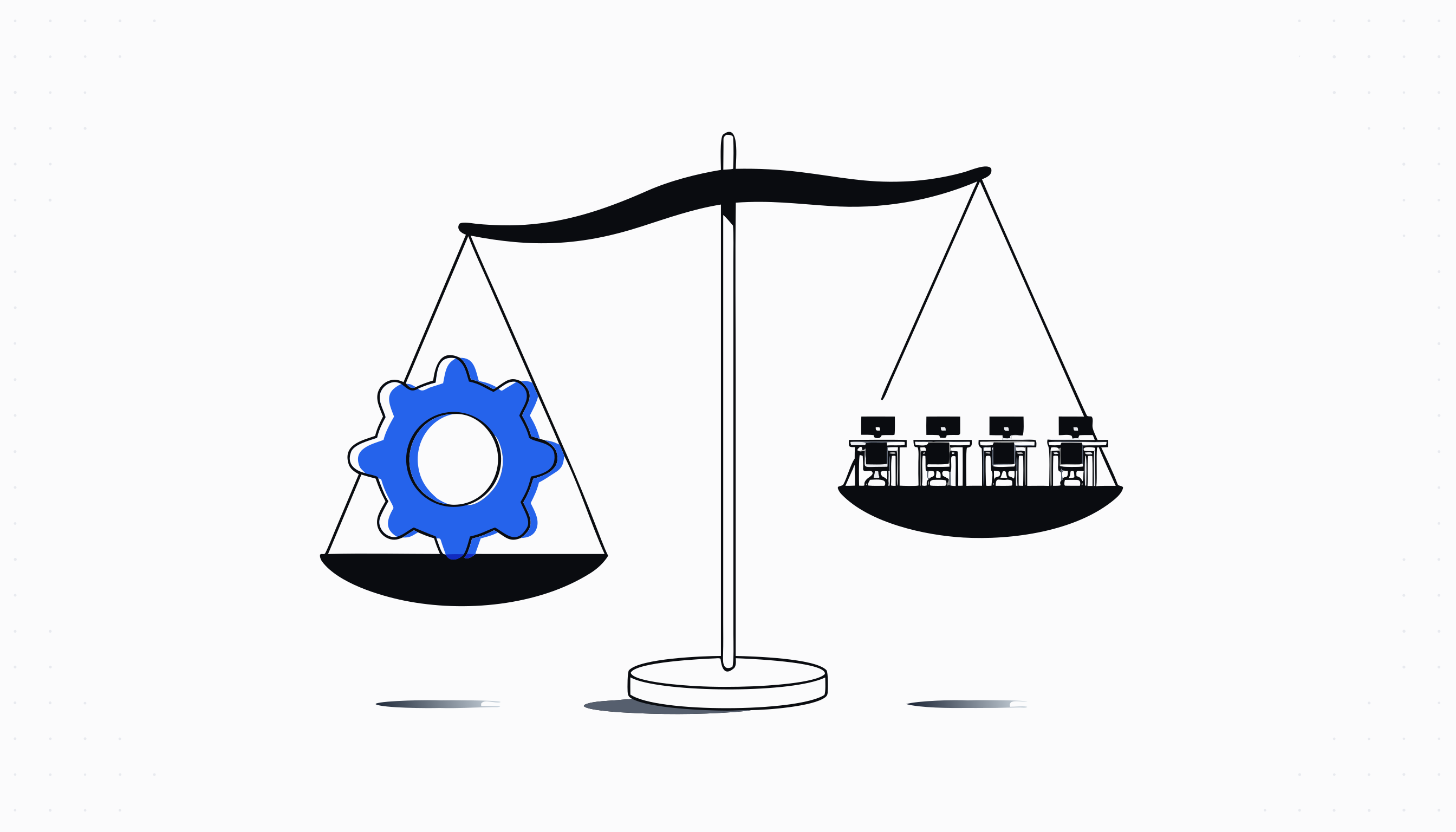
Should a growing Shopify store hire someone or automate first?
Automate first, in almost every case, because a hire is the most expensive and least reversible way to buy capacity. An employee costs salary, onboarding time, and a slice of your attention every single day. If the person is wrong for the role, unwinding it costs months. An AI workflow that turns out to be wrong for a job costs you the time it took to set up and nothing else.
There is a second reason that matters more than cost. Hiring before you have documented, repeatable processes means you hire someone to figure out your business alongside you. Automating first forces you to define the job precisely: what comes in, what a good output looks like, what must never happen without your sign off. Once a job is defined that clearly, you know exactly what to automate and, later, exactly what to hire for.
The exception is real: some jobs should never be your first automation target. Anything built on taste, relationships, or accountability for money stays with a person for now. The rest of this article sorts the common store jobs into those two piles.
What makes a job a good fit for AI execution?
A job converts well to AI execution when it is repeatable, checkable, and reversible. Repeatable means the same kind of input arrives over and over: a customer email, a product that needs a page, an abandoned cart. Checkable means you can look at the output and judge it in seconds. Reversible means a bad output caught in review costs nothing, because it never reached a customer.
The pattern that makes this safe is AI execution with human approval. The AI does the work: it drafts the reply, builds the creative, plans the campaign. You do the judgment: approve, edit, or reject. Done well, your role shifts from producing work to reviewing work, which is a far better use of a founder's hour. You review a drafted support reply in ten seconds. Writing it yourself takes several minutes.
The trust boundary should be yours to move, not fixed by the tool. Early on, everything waits for your approval. As the drafts consistently need no edits, you hand over the routine cases and keep approval only for the consequential ones: refunds, budget changes, anything a customer sees that you have not seen a hundred times before.
- Repeatable: the same category of input arrives constantly
- Checkable: you can judge the output in seconds, not hours
- Reversible: a rejected draft costs nothing because nothing shipped
- Adjustable: you decide where automatic ends and approval begins, and you can move that line
What should you automate first? Start with customer support
Support is the first job to hand to an AI workforce, because it scores highest on every test above. The volume grows in lockstep with orders, most tickets are variations of the same few questions, and every answer already lives in your order data and policies. It is also the job most likely to force a premature hire, because inbox pressure is daily and visible in a way that marketing debt is not.
The key is that good support automation reads the actual order, not a script. An AI that can see where the parcel is, whether the shipping address can still be changed, and what your return policy means for this specific order can resolve the routine tickets outright. One that answers from a generic knowledge base just generates polite messages that still need a human to finish the job.
The cases that touch money or a shipment are exactly where the approval model earns its keep. A refund request, an unusual complaint, or a message the AI is not confident about should never get an automatic answer. It should land in a review queue with a drafted reply attached, so your involvement drops from writing every response to spending seconds approving the few that carry real consequences.
When do creatives and ads convert to AI execution?
Creatives convert as soon as support is stable, because creative production is a volume problem wearing a quality costume. Paid social burns through ad variations relentlessly, and the traditional answers are all bad for a growing store: a freelancer with a per asset invoice, an agency retainer, or your own evenings. Generating static and video ad variations from your product content, against layouts that already convert, turns a bottleneck into a review queue. You are still the taste filter. You are just no longer the production line.
Ad management follows creatives, with a harder boundary, because ads spend money and money is where automation must stay on a leash. The planning layer converts well: campaign structure, audiences, budgets, and ad copy drafted from your actual catalogue is exactly the kind of repeatable, checkable work AI handles reliably. The launch decision does not convert. Every campaign should wait for your explicit approval, budgets should never change themselves outside rules you wrote, and every automated action should be logged where you can read it.
The order matters here. Automating ad execution before you have a steady creative supply just helps you exhaust your two working creatives faster. Creatives first, then campaigns.
Where do retention and search fit in the sequence?
Retention comes next because it is the highest value job that most growing stores simply skip. Welcome flows, abandonment sequences, winbacks, and campaigns are almost pure execution: the segments and triggers are well understood, and the writing is repeatable once your brand voice is captured. The reason retention email goes unsent at most stores is not that it is hard. It is that it always loses the priority fight against whatever is on fire today. That is precisely the profile of a job that should run itself, drafting from real purchase behaviour, with you approving the output.
Search, meaning SEO and Google Ads, converts last, not because it automates poorly but because it pays back slowly. SEO execution is a long grind of technical fixes, search titles, articles, and internal links: high volume, low glamour, and a compounding return that only arrives if the work actually ships month after month. That grind is exactly what AI execution is for, applied as approved changes to your store rather than delivered as a report you never act on. On the paid side, a drafted search campaign with keywords, structure, ads, and negatives prepared is a strong use of AI, with the same hard rule as Meta: nothing spends your budget without your decision.
Sequence the whole thing by payback speed. Support pays back this week, creatives and ads this month, retention this quarter, search over the next several. Automating in that order means each layer is stable and needing only review time before you add the next.
Where does a human stay essential?
A human stays essential wherever the job is deciding rather than producing. AI execution with approval removes the production bottleneck, but it deliberately concentrates the decisions with you, and some of those decisions never delegate well to software or to a first hire.
Strategy and offer design stay human: what you sell, at what price, to whom, and why anyone should care. Brand taste stays human, because an approval model only works if the approver has a real opinion about what is on brand and what is not. Accountability for money stays human: budgets, refund thresholds, and supplier commitments need a person who owns the consequences. And relationships stay human, from the supplier negotiation to the furious customer whose problem sits outside every policy, to the partnership that starts with a conversation no AI should have on your behalf.
This reframes the hiring question rather than deleting it. Your first hire should not be the person who answers tickets or resizes creatives, because that work is already handled. It should be someone who takes over a slice of judgment: reviewing the queues, owning a channel's results, making the calls you currently make. That is a better job, hired later, with a far clearer definition, and it is usually a hire you can now actually afford.
- Strategy and offer design: what you sell, at what price, to whom, and why
- Brand taste: judging what is genuinely on brand and what is not
- Accountability for money: budgets, refund thresholds, supplier commitments
- Relationships: supplier negotiations, partnerships, and the rare customer situation outside every policy
How Zyberon structures an AI workforce
We built Zyberon around this exact sequence, so it is organised as pillars that map to the jobs above rather than as a pile of disconnected tools. There is a pillar for customer support, one for creative production across static ads, video ads, and research, one for Meta ads, one for retention covering email marketing and bundle offers, and one for Google covering SEO and Google Ads, alongside pillars for funnels, social, product research, and profit tracking. A store can adopt them in the payback order this article describes, one at a time, and each pillar draws on a shared brand and product profile so the output sounds like the store rather than like a template.
The approval model is the same everywhere, on purpose: Zyberon drafts, you decide, and nothing irreversible happens on its own. Consequential support cases wait in review queues with a drafted reply attached. Generated ads sit in a review tab before anything reaches Meta. SEO changes are proposals you approve or skip, and a Google Ads proposal waits in your dashboard because Zyberon never spends your budget on its own. Confidence thresholds and per channel draft modes let you decide exactly where automatic ends and approval begins, and move that line as trust builds.
Above the pillars sits a steering layer: an AI manager that watches every running pipeline and surfaces what needs a decision, and a team chat where you assign work, review what came back, and approve it in one thread. That is the shape of the argument in this article turned into a product: the AI does the producing, you do the deciding, and the deciding keeps getting easier to do from one place. Whether you build that structure with Zyberon or assemble it yourself, the sequence and the approval discipline are what make an AI workforce something you audit occasionally instead of something you babysit.
How this compares to the tools you are weighing
A virtual assistant
- What it does well
- A virtual assistant brings real judgment and can pick up ad hoc tasks a script was never written for.
- Where it stops
- Hiring one still means training time, ongoing management, and covering the role during holidays or when they leave.
- What Zyberon does instead
- Zyberon's steering layer runs an AI manager that watches every pipeline continuously, so the work does not pause when one person logs off.
An agency retainer
- What it does well
- An agency retainer can bring real creative and channel expertise built from work across many other stores.
- Where it stops
- A retainer is a recurring cost independent of output, and every campaign or creative decision runs through a separate team you brief and wait on.
- What Zyberon does instead
- Zyberon drafts campaigns, creatives, and copy from your own catalogue inside one workspace you approve them in, and nothing spends your budget without your decision.
A stack of separate point tools
- What it does well
- A stack of specialist point tools can each genuinely be the strongest option in its own narrow category.
- Where it stops
- Each tool is a separate purchase, a separate login, and a separate integration to keep working, and none of them share what the others learn about your store.
- What Zyberon does instead
- Zyberon's pillars share one Brain profile of your brand, products, and customers, so a generator for ads, email, or support all reads the same facts instead of starting cold.
Questions this raises
Is an AI workforce actually cheaper than hiring for a Shopify store?
The bigger difference is reversibility, not just price. A hire costs salary plus onboarding plus daily management, and a wrong hire takes months to unwind. An AI workflow that does not fit a job costs the setup time and nothing else, and the work it does well arrives without adding anyone to manage. Most growing stores get more capacity per euro from automation first, then hire for judgment later.
What should a Shopify store automate first?
Customer support. Ticket volume grows in lockstep with orders, most tickets are variations of the same questions, and the answers live in your order data. It is also the job most likely to force a premature hire. Automate it with a review queue for anything touching money or shipments, then move to creatives, ads, retention, and search in that order.
Will AI send things to my customers without my approval?
Only if you configure it to. The safe pattern is draft mode by default: the AI produces the reply, ad, email, or page change, and it waits in a queue for your approval. You then move the line deliberately, letting routine cases go out automatically while refunds, budgets, and anything uncertain still wait for you.
Which jobs should I never fully automate?
Anything that is deciding rather than producing. Strategy, pricing, and offer design stay human. Brand taste stays human, because approval only works if the approver has a real opinion. Accountability for money stays human, and so do relationships: supplier negotiations, partnerships, and the rare customer situation that sits outside every policy.
When is the right time to make my first hire?
After the repeatable work is automated and you can no longer keep up with the reviewing and deciding. At that point you hire for judgment, not production: someone to own a channel's results and clear the approval queues you currently clear yourself. You will define the role better, afford it more easily, and waste none of their time on work software already handles.
Read next
AI Answer Engines Are Rewriting Ecommerce SEO in 2026
AI answer engines like Google AI Overviews, ChatGPT and Perplexity are changing ecommerce SEO in 2026. Here is what a Shopify store owner should do now.
Shopify SEO Tools Compared: What Each One Actually Solves
A category by category comparison of Shopify SEO tools, including Semrush, Ahrefs and Surfer SEO, and which job to solve first.
A Meta Ads Creative Testing Cadence for Shopify Stores
A meta ads creative testing cadence for Shopify: how many concepts to run each week, how many variants each needs, and exactly when to kill a loser.